 Bromley Electrical Services
Guide
How long an EICR takes and what is involved
An EICR on a typical three-bedroom home takes a few hours. Here is what the inspector checks, what affects the time and what the report tells you.
- Send a short enquiry
- Covering Greater London
- EICR and related services
An EICR on a typical three-bedroom house usually takes a few hours, while larger homes, older wiring or commercial premises can take a full day or more. The time depends mainly on the number of circuits, how easy the wiring is to reach and the condition of the installation. Bromley Electrical Services provides EICRs for homeowners, landlords and commercial customers in Bromley and across Greater London.
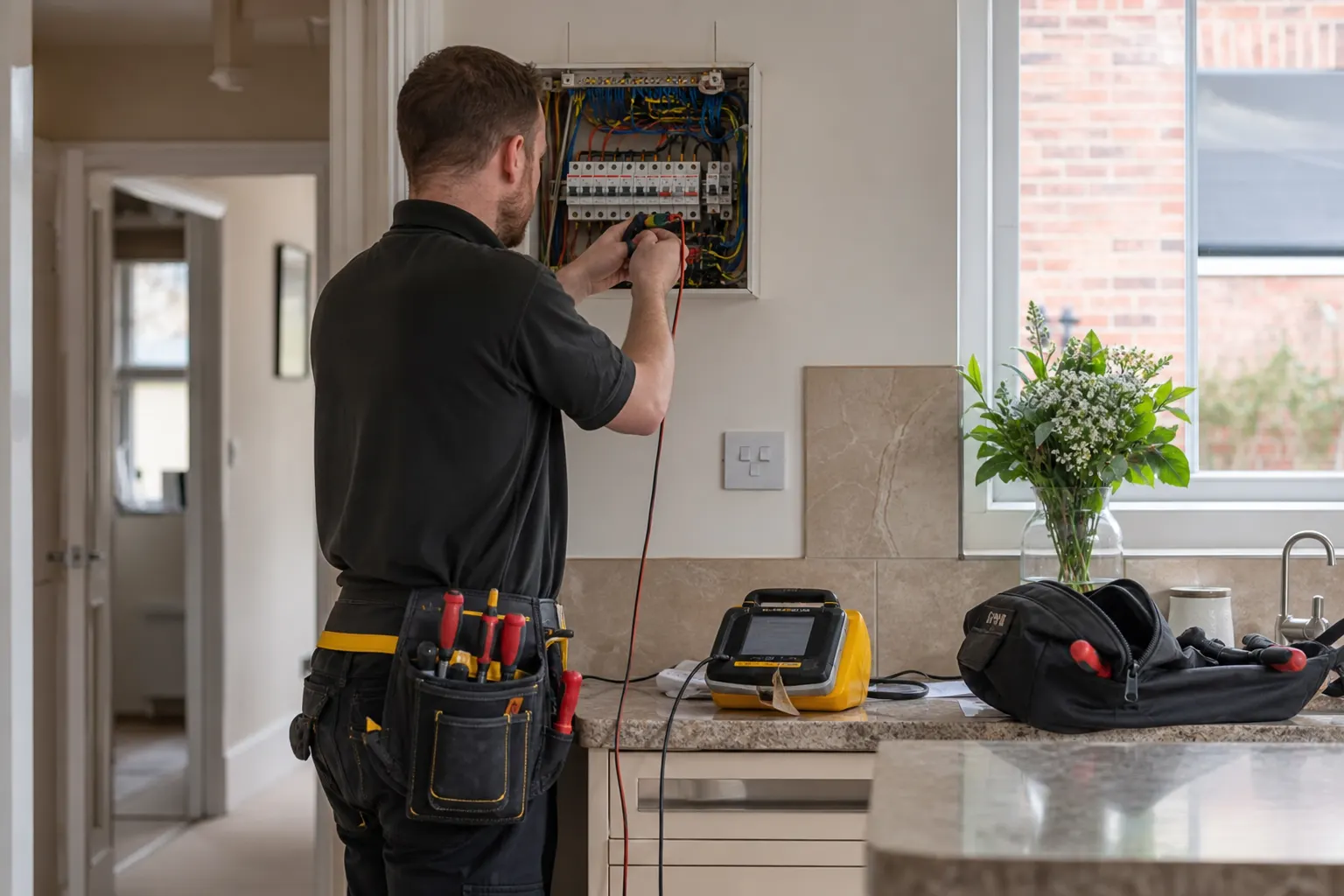
What EICR stands for and what it covers
EICR stands for Electrical Installation Condition Report. It is a formal inspection of the fixed electrical installation in a property: the consumer unit (fuse board), the wiring, sockets, light fittings and switches, earthing and bonding.
It is not the same as PAT testing, which checks portable appliances such as kettles and desk lamps. An EICR looks at the permanent wiring that sits behind the walls and in the fuse board.
How long it takes and what changes that
For an average three-bedroom house, expect a few hours on site. A small flat is often quicker. A large house, a property with several fuse boards or a commercial unit will take longer.
The main things that affect the time are:
- The number of circuits. Each circuit is tested separately. - Access. Locked rooms, furniture in front of sockets, loft hatches that are hard to reach and meters in awkward spots all slow things down. - Age and condition. Older installations, or ones that have been altered several times, take longer to trace and test. - Missing information. If there are no previous records or the fuse board is not labelled, the inspector has to identify each circuit by hand. - Problems found. If something unsafe turns up, it needs investigating and recording properly.
What happens during the inspection
The inspection has two parts. First comes a visual check: the inspector looks for damaged fittings, signs of overheating, missing covers, poor connections and anything that does not look right in the fuse board.
Then comes testing with specialist equipment. This measures things like earth continuity, insulation resistance and how the protective devices respond to a fault. To do this safely, the power is switched off to parts of the property, often one circuit at a time and sometimes for the whole property for a period. Plan around this: save your work on computers, and think about anything that needs constant power, such as medical equipment, alarms or a freezer. Tell the inspector about these in advance.
If you have data cabling, a home office or other sensitive equipment, mention it beforehand so it can be handled sensibly.
What the report tells you
Once the testing is finished, you receive a written report. It gives an overall result of satisfactory or unsatisfactory, plus any observations, each with a code:
- C1: danger present, immediate action needed. - C2: potentially dangerous, urgent attention needed. - C3: improvement recommended. - FI: further investigation required.
A report with any C1, C2 or FI is normally unsatisfactory. C3 items alone do not usually make a report unsatisfactory, but they are worth reading.
What happens if the result is unsatisfactory
An unsatisfactory result is not a verdict that the whole house needs rewiring. It means specific faults need fixing. The usual next step is to get the remedial work quoted and carried out, then have the issues confirmed as resolved.
Landlords should take this seriously, as rules on electrical safety in rented homes can require action within set timescales. The rules can change, so check GOV.UK for the current position.
How to prepare and how pricing works
Before the visit, clear access to the fuse board, meter and any outbuilding supplies, and make sure someone can let the inspector into every room. Have any older electrical certificates to hand.
EICR pricing generally depends on the size of the property, the number of circuits, access, the age of the installation and how long the inspection is expected to take. Some firms quote a fixed price after hearing the details, others work by time. Ask for a written quote that says what is included, and whether remedial work is priced separately.
Common questions
How long does an EICR last?
The report records the condition on the day of inspection and recommends a date for the next one. For rented homes the interval is commonly set at five years or less, and owner-occupied homes often use a longer interval. The inspector sets the recommended date based on condition, so check GOV.UK for current rules.
How long does it take to get an EICR for a three-bedroom house?
The inspection itself typically takes a few hours. The written report usually follows after the testing is complete. Access, the number of circuits and any problems found can all extend the time.
What happens if you fail an EICR?
The report is marked unsatisfactory and lists the faults with codes. The faults need to be repaired, and the work should then be confirmed as complete. Landlords may have deadlines for doing this, so check GOV.UK.
Do I need to be at home during an EICR?
Someone over 18 should usually be there to give access and agree when power is switched off. Landlords can often arrange access through tenants, with proper notice.
Useful sources
- NICEIC: The electrical contracting body, with a register to check an electrician.
- GOV.UK: electrical safety standards in the private rented sector: The official guidance for landlords, tenants and councils on electrical safety checks.